Water Leak Detection in
Bethnal Green & East London
Find a hidden leak before it destroys your floors, ceilings and walls. Our thermal imaging, acoustic and tracer gas equipment locates leaks to within centimetres — no smashing tiles, no guesswork.
★ From £180 · Insurance-approved reports · Same-day call-out · 24/7 emergency
£180
From
<2hrs
Typical Locate Time
97%
First-Visit Find Rate
24/7
Emergency Response
Insurance
Approved Reports
What Is Non-Destructive Leak Detection?
Non-destructive leak detection uses specialist equipment — thermal imaging cameras, acoustic listening devices, tracer gas, moisture meters and pressure testing — to locate hidden water leaks behind walls, under floors and inside concrete slabs without tearing up your home to find them.
Most water leaks in London properties are hidden: pinhole corrosion in copper pipework, failed compression joints buried in screed, leaking radiator tails under floorboards, slow drips from concealed shower waste pipes. By the time you see the damage — a damp patch on a ceiling, mould on a wall, a constantly running water meter — the leak has often been active for weeks.
MAMOSS leak detection in Bethnal Green and across East London pinpoints the source within centimetres in under 2 hours on the average call-out, allowing a single small repair access — instead of ripping up an entire floor on a guess. Reports are insurance-approved and accepted by all major UK home insurers.
- Thermal imaging — locates hot/cold leaks behind walls and under floors
- Acoustic correlation — pinpoints leaks under concrete slabs
- Tracer gas (hydrogen/nitrogen) — finds tiny leaks in mains pipework
- Moisture mapping — confirms extent of water damage
- Pressure testing — confirms system integrity after repair
- Insurance-grade written report with photos
- Same-day appointments across East London
- 24/7 emergency call-out for active major leaks
Signs You Have a Hidden Water Leak
A hidden leak almost always shows itself indirectly long before the water becomes visible. If you have any of the following, book a leak detection survey immediately — every day of delay multiplies the damage cost:
Unexplained High Water Bills
A sudden jump of 20%+ in water usage with no change in lifestyle is the classic sign of a hidden leak. Even a tiny pinhole leak can leak hundreds of litres per week.
Water Meter Spinning When Nothing Is On
Turn off every tap and water-using appliance. If your meter is still ticking over, water is escaping somewhere on your supply pipework — a textbook leak detection job.
Damp Patches on Walls or Ceilings
A spreading damp patch, brown stain or paint blistering almost always traces back to a hidden leak — often metres away from where the damage shows, as water travels along joists and pipework.
Boiler Pressure Constantly Dropping
If you keep having to top up your boiler pressure every few weeks, the central heating system is leaking somewhere. Often it is a buried pipe under a floor or a corroded radiator tail.
Hissing or Trickling Sounds
A faint hissing or trickling sound when the house is quiet — especially behind a wall or near pipework — is often a high-pressure leak. Acoustic detection equipment finds these in minutes.
Warm Spots on Floors
An unexplained warm patch on a floor often indicates a leaking hot water or central heating pipe in the screed below. Thermal imaging confirms the location precisely.
Our Process
Our Leak Detection Process
Initial Site Survey
We discuss the symptoms with you, inspect visible damage, and check the water meter and boiler pressure. This narrows the leak to mains supply, central heating, hot water, or waste pipework.
Pressure Testing
We isolate sections of the suspected system and pressure-test each in turn to confirm which circuit is leaking. This eliminates 90% of the property before specialist equipment comes out.
Thermal Imaging Survey
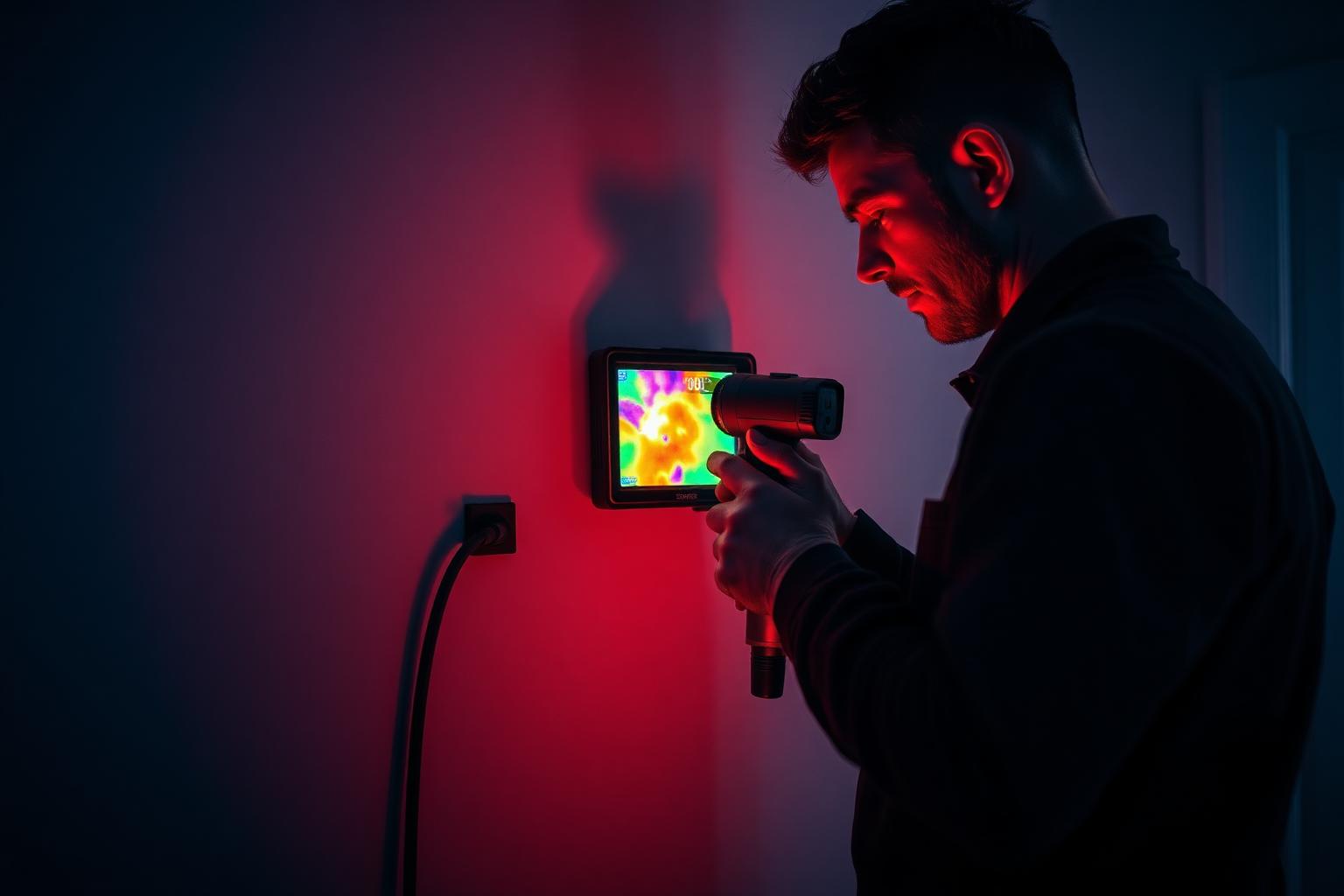
A FLIR thermal camera scans walls, floors and ceilings to identify temperature anomalies caused by escaping hot water or evaporative cooling from cold water leaks. Most leaks show clearly within minutes.
Acoustic Detection
For leaks under concrete or in mains supply pipework, we use ground microphones and acoustic correlators to listen for the characteristic high-frequency hiss of pressurised water escaping.
Tracer Gas (If Required)
For very small or intermittent leaks, we introduce a safe hydrogen-nitrogen tracer gas into the pipework and use a detector to follow the gas to its escape point. Locates leaks down to a single drip per minute.
Pinpoint Report & Repair Quote
We mark the leak location to within a few centimetres, document everything in a written insurance-grade report (with photos and thermal images), and provide a quote for the repair — which we can usually carry out the same day.
The Benefits of Professional Leak Detection
Find the Leak, Not a Guess
Avoid the cost and disruption of speculative excavation. Pinpoint location means a single small access hole instead of ripping up a whole floor.
Stop Water Damage Spreading
Every day a leak runs, structural damage spreads — rotted joists, ruined plaster, mould, electrical corrosion. Fast detection minimises rebuild cost.
Insurance-Approved Reports
Our written reports include photos, thermal images, location diagrams and findings — the format every UK home insurer requires for water-damage claims.
Reduce Water Bills
A pinhole leak can waste 50,000+ litres per year. Finding and fixing it pays for the survey within months on the water bill alone.
Protect Boiler & Heating
Topping up boiler pressure introduces oxygen and fresh tap water — accelerating corrosion of radiators and pumps. Stopping the underlying leak protects the entire system.
Same-Day Repair
Once located, most leaks can be repaired on the same visit. We carry copper, plastic, compression and push-fit fittings on the van as standard.
Leak Detection in Detail: Equipment, Methods & Limits
Modern non-destructive leak detection combines four core technologies. Thermal imaging is the fastest first-pass survey: a calibrated FLIR camera identifies temperature differences as small as 0.1°C — enough to spot a hot water pipe leak under a tiled floor or a cold water leak evaporating behind plaster.
Acoustic detection is the workhorse for hard-to-reach leaks. Pressurised water escaping from a small hole creates a distinctive high-frequency hiss that travels through pipe walls and surrounding material. Specialist ground microphones and noise correlators triangulate this sound to within 10-20 cm of the leak — even through 200 mm of concrete.
Tracer gas is the gold-standard final-pass technique. A safe non-toxic mixture (95% nitrogen, 5% hydrogen) is introduced into the depressurised pipework. The hydrogen — the smallest molecule in the universe — escapes through any leak and rises to the surface, where a sensitive detector picks it up. Finds leaks too small to make any noise at all.
Moisture mapping with a calibrated dielectric meter then confirms the boundary of the wet area, distinguishing a recent active leak from old historic damp. This matters for insurance claims — insurers will challenge claims where the moisture pattern does not match a recent event.
Honesty matters: leak detection is not magic. About 3% of leaks (intermittent low-pressure leaks behind dense materials) require a small inspection cut to confirm. We will always tell you upfront when this is likely and minimise any access required. Our 97% first-visit find rate is industry-leading.
- FLIR thermal imaging camera (calibrated annually)
- Acoustic correlator and ground microphones
- Hydrogen-nitrogen tracer gas equipment
- Calibrated dielectric moisture meter
- Pressure testing kit (mains, heating, hot water)
- Endoscope camera for confined-space inspection
- Insurance-approved written report format
- Same-day repair capability for located leaks
Explore more of our services:
FAQ
Frequently Asked Questions
Related Reading & Guides
Available Across London

Ready to Solve Your Property Problem?
Speak to a qualified engineer today. No obligation estimates, transparent pricing, and rapid response across London.